
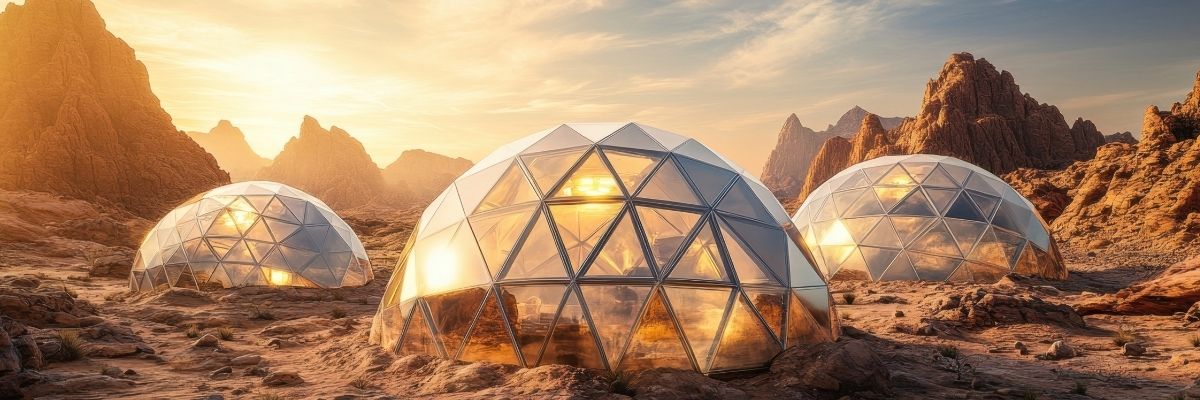
Imagine stepping off a spacecraft and into your new home, not on Earth, but orbiting Mars, nestled in a lunar crater, or even drifting through the vast expanse of space. This isn’t science fiction anymore; it’s a rapidly approaching reality. Designing habitats for deep space missions presents unique challenges, forcing us to rethink everything we know about living spaces and sustainable life support.
Why We Need Homes Beyond Earth (And Why They’re So Tricky to Build)
Venturing beyond Earth’s protective atmosphere and magnetic field necessitates constructing habitats that are not only comfortable but also capable of shielding inhabitants from radiation, extreme temperatures, and the psychological challenges of isolation. Think of these habitats as miniature, self-sustaining Earths, capable of providing everything humans need to survive and thrive for extended periods. The challenges are immense:
- Radiation Shielding: Deep space is bombarded with cosmic radiation and solar flares, posing a significant health risk. Solutions range from burying habitats beneath lunar or Martian regolith (surface soil) to using advanced materials like water-filled walls or electromagnetic shields.
- Life Support Systems: Recycling air and water becomes paramount. Closed-loop systems that mimic Earth’s natural processes are essential for long-duration missions. This includes advanced filtration, waste processing, and even growing food within the habitat.
- Psychological Well-being: Isolation and confinement can take a toll on mental health. Habitats need to be designed with spacious living areas, natural light (or simulated light), and opportunities for recreation and social interaction.
- Resource Utilization: Transporting everything from Earth is impractical and expensive. Utilizing in-situ resource utilization (ISRU) – extracting and processing resources already present on the Moon, Mars, or asteroids – is crucial for building and sustaining these habitats.
- Structural Integrity: Habitats must withstand the harsh conditions of space, including micrometeoroid impacts, extreme temperature fluctuations, and, if on a planetary surface, potential seismic activity or dust storms.
So, What Do These Future Homes Actually Look Like?
The design possibilities are vast, limited only by our imagination and technological capabilities. Here are some of the most promising concepts:
Underground Habitats: Digging In for Protection
Burying habitats beneath the surface of the Moon or Mars offers excellent radiation shielding and temperature regulation.
- Pros: Superior radiation protection, stable temperatures, protection from micrometeoroids.
- Cons: Complex excavation required, potential for geological instability, difficulty in accessing natural light.
- Examples: Concepts for lunar lava tube habitats or Martian subsurface bases. The idea is to use existing natural formations, like lava tubes, or to excavate artificial caverns.
Inflatable Habitats: Pop-Up Space Living
Inflatable habitats offer a lightweight and relatively easy-to-deploy solution. They can be expanded on-site, providing a large internal volume.
- Pros: Lightweight for transport, large internal volume, relatively easy deployment.
- Cons: Vulnerable to punctures, requires robust structural reinforcement, potential for leaks.
- Examples: The Bigelow Expandable Activity Module (BEAM) tested on the International Space Station (ISS). Future designs incorporate multiple layers of puncture-resistant materials and radiation shielding.
3D-Printed Habitats: Building with Local Resources
3D printing, using materials found on the Moon or Mars (regolith), offers the potential to construct habitats in situ, reducing the need to transport building materials from Earth.
- Pros: Utilizes local resources, customizable designs, potentially lower cost.
- Cons: Requires advanced 3D printing technology, challenges in material processing, structural integrity concerns.
- Examples: NASA’s 3D-Printed Habitat Challenge. The goal is to develop technologies for autonomously constructing habitats using Martian or lunar regolith.
Rotating Habitats: Creating Artificial Gravity
In deep space, prolonged exposure to microgravity can lead to bone loss, muscle atrophy, and other health problems. Rotating habitats generate artificial gravity through centrifugal force.
- Pros: Mitigates the effects of microgravity, provides a more Earth-like environment.
- Cons: Complex engineering and construction, potential for motion sickness, requires significant energy to maintain rotation.
- Examples: The Stanford Torus and the O’Neill Cylinder, classic concepts for large-scale space habitats. Smaller, more practical rotating modules are also being explored.
Surface Habitats: Living Under Domes
Surface habitats, often envisioned as domes or modular structures, offer easy access to the surrounding environment and the potential for expansion.
- Pros: Easy access to the surface, relatively simple construction (compared to underground or rotating habitats), potential for expansion.
- Cons: Requires robust radiation shielding, vulnerable to micrometeoroid impacts and extreme temperatures, psychological challenges of living under a dome.
- Examples: Concepts for Martian surface habitats using modular designs that can be connected and expanded over time. Often incorporate inflatable or 3D-printed elements.
Key Design Considerations: Making Space Feel Like Home
Beyond the basic structural requirements, several key design considerations are crucial for creating a livable and sustainable deep-space habitat:
- Life Support Systems: These systems are the heart of any deep-space habitat, responsible for recycling air and water, managing waste, and providing food. Closed-loop systems that minimize reliance on external resources are essential.
- Power Generation: Reliable power is critical for all habitat functions. Solar power is a viable option on the Moon and Mars, but nuclear power or advanced energy storage systems may be necessary in deep space or during Martian dust storms.
- Food Production: Growing food within the habitat provides a sustainable source of nutrients and reduces the need to transport food from Earth. Hydroponics and aeroponics are common techniques used in space agriculture.
- Radiation Shielding: As mentioned earlier, protecting inhabitants from radiation is paramount. This can be achieved through a combination of physical barriers (like regolith), water-filled walls, and electromagnetic shields.
- Psychological Support: Creating a psychologically healthy environment is essential for long-duration missions. This includes providing spacious living areas, natural or simulated light, opportunities for recreation and social interaction, and access to communication with Earth.
- Medical Facilities: Access to medical care is limited in deep space. Habitats must include well-equipped medical facilities and trained personnel to handle emergencies. Telemedicine can also provide access to remote medical expertise.
- Maintenance and Repair: Habitats must be designed for easy maintenance and repair. This includes using durable materials, providing access to critical systems, and training crew members in basic repair techniques.
The Materials We’ll Be Building With: Think Beyond Bricks and Mortar
Constructing habitats in deep space requires innovative materials that are lightweight, strong, radiation-resistant, and, ideally, readily available on-site.
- Regolith: Lunar and Martian regolith can be used as a building material for radiation shielding and structural support. 3D printing with regolith is a promising approach.
- Water: Water is an excellent radiation shield and can also be used for life support. Water-filled walls can provide both shielding and temperature regulation.
- Composites: Lightweight and strong composite materials are ideal for building habitat structures. Carbon fiber reinforced polymers are commonly used in aerospace applications.
- Metals: Aluminum, titanium, and steel are strong and durable metals that can be used in habitat construction. However, they are relatively heavy.
- Polymers: Advanced polymers can be used for inflatable structures and other habitat components. They are lightweight and flexible, but may require radiation shielding.
Frequently Asked Questions
- How will we get water in space? Water can be transported from Earth, extracted from lunar or Martian ice, or recycled from wastewater within the habitat.
- How will we protect ourselves from radiation? Radiation shielding can be achieved through physical barriers, water-filled walls, or electromagnetic shields.
- Can we really grow food in space? Yes, hydroponics and aeroponics are proven methods for growing food in space, as demonstrated on the ISS.
- How will we deal with waste in space? Closed-loop life support systems recycle waste into usable resources like water and nutrients for plant growth.
- What about the psychological effects of living in space? Habitats will be designed with spacious living areas, natural light, and opportunities for recreation and social interaction to mitigate psychological challenges.
The Future is Up: Designing for a New Frontier
Designing deep-space habitats is a complex and multifaceted challenge, requiring innovative solutions and a collaborative effort across disciplines. From underground bunkers to rotating space stations, the possibilities are vast. The key is to prioritize sustainability, resilience, and the well-being of the inhabitants, creating homes that not only allow us to survive but also to thrive in the vast expanse of space. By focusing on these elements, we can turn the dream of living among the stars into a tangible reality.