
The Cosmic Architects: Unraveling the Secrets of Planet Formation
Gazing up at the night sky, it’s easy to feel a sense of wonder at the countless stars, each a distant sun, many undoubtedly orbited by their own worlds. But have you ever stopped to truly ponder how these magnificent celestial bodies, including our own Earth, came into existence? The story of planet formation is one of cosmic dust, gas, gravity, and relentless collisions – a captivating saga that transforms diffuse matter into the vibrant, diverse planets we observe. Understanding this intricate process isn’t just about satisfying scientific curiosity; it’s about comprehending our cosmic origins and the universal conditions that allow life itself to flourish.
Where It All Begins: The Stellar Nurseries
Imagine vast, cold clouds of gas and dust stretching light-years across the galaxy. These are molecular clouds, the stellar nurseries where stars and planets are born. Our story begins here, long before any star lights up. These clouds are mostly hydrogen and helium, but they also contain tiny specks of heavier elements – the cosmic building blocks forged in the hearts of previous generations of stars.
Within these immense clouds, gravity starts to play its role. Even tiny fluctuations in density can cause small regions to begin collapsing under their own weight. As these regions shrink, they become denser and hotter, eventually forming a protostar – a star-to-be that hasn’t yet ignited nuclear fusion.
But here’s the crucial part for planets: not all the material falls directly into the protostar. Because the original cloud had some rotational motion, as it collapses, this motion intensifies, much like a spinning ice skater pulling in their arms. This causes the material to flatten out into a rotating disk around the young protostar. This disk, aptly named a protoplanetary disk, is where all the magic of planet formation truly happens. It’s a swirling, flattened pancake of gas and dust, extending hundreds of astronomical units from the central star, and it holds the future planets in its grasp.
From Cosmic Dust to Tiny Pebbles: The First Sticky Steps
Inside the protoplanetary disk, the conditions are just right for things to start sticking together. The tiny dust grains – microscopic particles of rock and ice, similar in size to smoke particles – are constantly colliding. At this early stage, electrostatic forces (the same static cling that makes socks stick together in a dryer) are incredibly important. These gentle forces allow dust grains to lightly clump together.
Think of it like snow falling: individual flakes are tiny, but they easily stick to form larger aggregates. In the disk, these dust grains slowly accumulate into larger and larger clumps.
This process of small particles gradually growing by colliding and sticking is known as accretion. Over thousands to millions of years, these dusty aggregates grow from micron-sized particles into millimeter-sized pebbles, then centimeter-sized chunks. It’s a slow, painstaking process, but it’s the absolutely fundamental first step.
The Big Leap: Building Boulders and Beyond
As these pebbles grow, they start to interact more strongly with the gas in the disk. This interaction can cause them to drift inwards towards the central star. However, some theories suggest that turbulent eddies and pressure bumps within the disk can also act like cosmic traffic jams, concentrating these pebbles into denser regions.
Once these clumps reach a size of about a meter, electrostatic forces aren’t enough to hold them together against collisions, and gas drag becomes significant. This is a crucial hurdle in planet formation, often called the “meter-size barrier.” Scientists believe that gravitational instability within these concentrated pebble fields might be the solution. Essentially, if enough pebbles gather in one spot, their collective gravity can rapidly pull them together, overcoming gas drag and forming much larger objects.
This rapid growth leads to the formation of planetesimals – objects ranging from a kilometer to hundreds of kilometers in size. These are the true building blocks of planets. At this stage, gravity takes over as the dominant force. Planetesimals constantly collide with each other. Some collisions are destructive, shattering objects into smaller pieces, but many are constructive, leading to further growth. This phase is often described as “runaway growth” because the largest planetesimals, having the strongest gravity, tend to sweep up material faster than smaller ones, growing even larger at an accelerating rate.
Gas Giants vs. Rocky Worlds: A Tale of Two Formation Paths
The location within the protoplanetary disk plays a massive role in determining what kind of planet will form. This is largely due to the frost line (sometimes called the “snow line” or “ice line”).
- The Frost Line Defined: This is the specific distance from the protostar where it’s cold enough for volatile compounds like water, methane, and ammonia to condense into solid ice grains. Closer to the star, it’s too hot for these ices to form; only silicates (rock) and metals can condense.
1. Building Rocky Planets (Like Earth and Mars):
- Inside the Frost Line: Here, only rocky and metallic planetesimals can form. These planetesimals continue to collide and merge through core accretion. Over tens of millions of years, these collisions build up larger and larger bodies, eventually forming the solid, rocky cores of terrestrial planets. Our own Earth, Mars, Venus, and Mercury are prime examples of planets formed this way. They are relatively small, dense, and composed primarily of rock and metal.
2. Building Gas Giants (Like Jupiter and Saturn):
- Outside the Frost Line: This is where things get really interesting for the giants! Beyond the frost line, there’s a much greater abundance of solid material because water ice, methane ice, and ammonia ice are now available in addition to rock and metal. This means that planetesimals forming in these outer regions can grow much larger and faster.
- Rapid Core Formation: These icy-rocky planetesimals quickly accrete into massive cores, sometimes reaching 5 to 10 times the mass of Earth.
- Runaway Gas Accretion: Once a core becomes sufficiently massive, its gravity is powerful enough to start directly pulling in the abundant hydrogen and helium gas from the surrounding protoplanetary disk. This process is incredibly efficient and rapid, often called runaway gas accretion. The core quickly balloons, accumulating vast atmospheres of gas, forming the colossal gas giants like Jupiter and Saturn, and the ice giants like Uranus and Neptune. They grow so large, so fast, that they essentially clear out much of the gas in their immediate vicinity.
Cleaning Up the Neighborhood: The Late Stages and Planetary Migration
Even after the main planets have formed, the planetary system is still a chaotic place. There’s a lot of leftover debris – smaller planetesimals, asteroids, and comets – that haven’t been incorporated into planets. The gravitational interactions between the nascent planets and this leftover debris, as well as with each other, can lead to significant changes.
- Planetary Migration: Planets don’t necessarily stay where they formed. Gravitational interactions with the gas and remaining planetesimals in the disk can cause planets to migrate inwards or outwards. This is particularly true for gas giants, which can clear paths through the disk, exchanging angular momentum and drifting from their birthplaces. The “Grand Tack” model, for instance, suggests Jupiter migrated inwards and then outwards in our early solar system, dramatically influencing the asteroid belt and the formation of the inner planets.
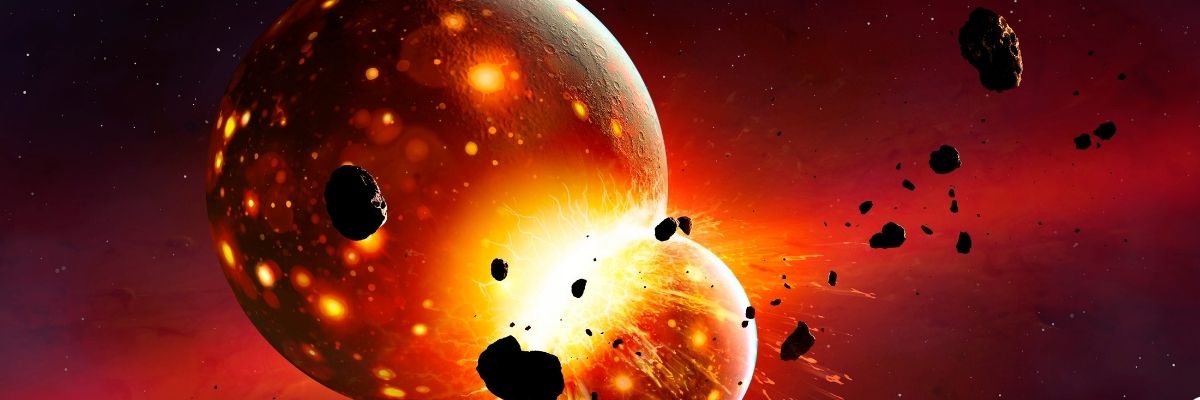
- Collisions and Scattering: The late stages are marked by intense bombardment. Many smaller bodies are ejected from the system, others collide with growing planets, contributing to their final mass or creating large impact craters. Our Moon is thought to have formed from a giant impact between early Earth and a Mars-sized protoplanet. The Late Heavy Bombardment, a period of intense impacts on the inner solar system planets and moons, is evidence of this chaotic cleanup phase.
Eventually, after tens to hundreds of millions of years, the leftover gas and dust are either accreted by planets, ejected from the system by the stellar wind, or simply dissipate. What remains is a relatively stable planetary system, like our own Solar System, with its planets orbiting a mature star.
Beyond Our Solar System: Exoplanets and Different Stories
The study of exoplanets – planets orbiting stars other than our Sun – has revolutionized our understanding of planet formation. We’ve discovered an incredible diversity of planetary systems, many of which don’t resemble our own.
- Hot Jupiters: Massive gas giants orbiting incredibly close to their stars, often within the equivalent of Mercury’s orbit. Their existence strongly supports the idea of significant planetary migration, as they couldn’t have formed in such hot, inner regions.
- Super-Earths and Mini-Neptunes: Planets larger than Earth but smaller than Neptune are incredibly common. These suggest different formation pathways or compositions than the planets in our solar system.
- Eccentric Orbits: Many exoplanets have highly elliptical orbits, unlike the nearly circular paths of planets in our solar system, indicating chaotic gravitational interactions in their past.
These discoveries constantly challenge and refine our models, showing that while the fundamental processes of accretion and gravity are universal, the specific outcomes can be incredibly varied, leading to a dazzling array of planetary architectures across the cosmos.
Frequently Asked Questions About Planet Formation
- What is a protoplanetary disk? It’s a rotating disk of gas and dust surrounding a young star, where planets are born through accretion.
- How long does planet formation take? The initial stages can take millions of years, with the final cleanup and stabilization extending to tens or even hundreds of millions of years.
- Do all stars have planets? While not every star might host planets, current data suggests that planets are incredibly common, with most stars likely having at least one.
- What is the frost line? It’s the distance from a star where it’s cold enough for water and other volatile compounds to condense into ice.
- What are planetesimals? They are kilometer-sized to hundreds-of-kilometers-sized rocky and icy bodies, serving as the building blocks of planets.
- Can planets form without a star? No, planets form from the leftover material in the protoplanetary disk surrounding a newly formed star.
- What is planetary migration? It’s the process where planets move from their initial formation locations due to gravitational interactions with the disk and other celestial bodies.
Bringing It All Together
The formation of planets is a grand cosmic ballet, a testament to the power of gravity and the slow, relentless process of accretion. From microscopic dust grains in a swirling disk to the majestic, diverse worlds we see today, it’s a journey of transformation that continues to unfold across the universe, offering endless possibilities for discovery and understanding. Every time you look up, remember the incredible journey each world has taken to become the unique place it is.